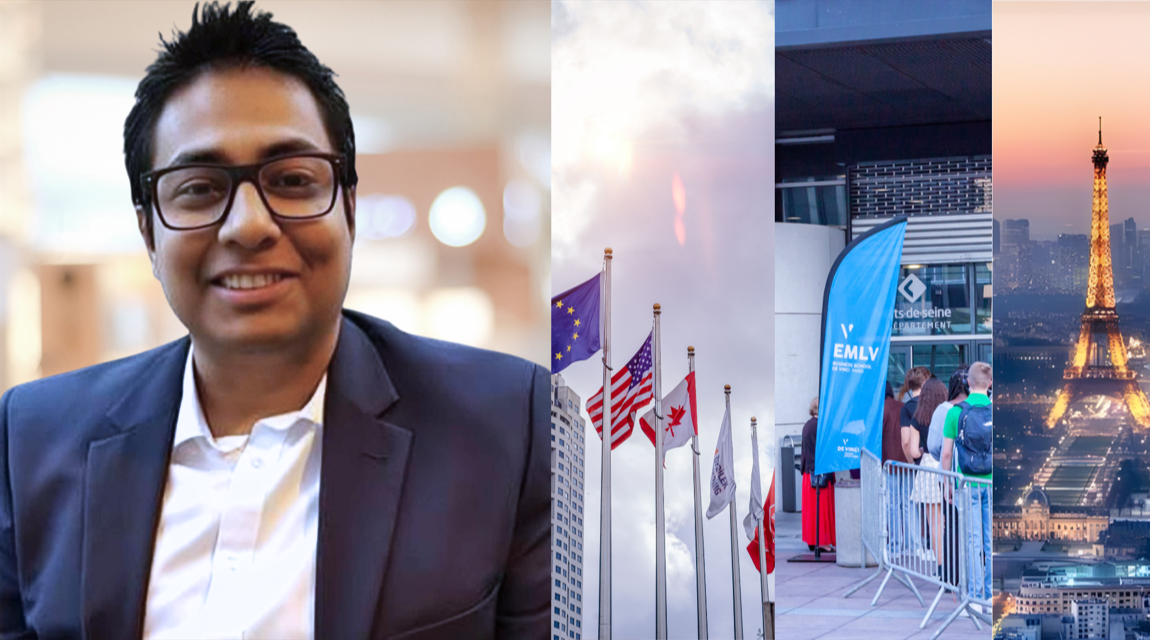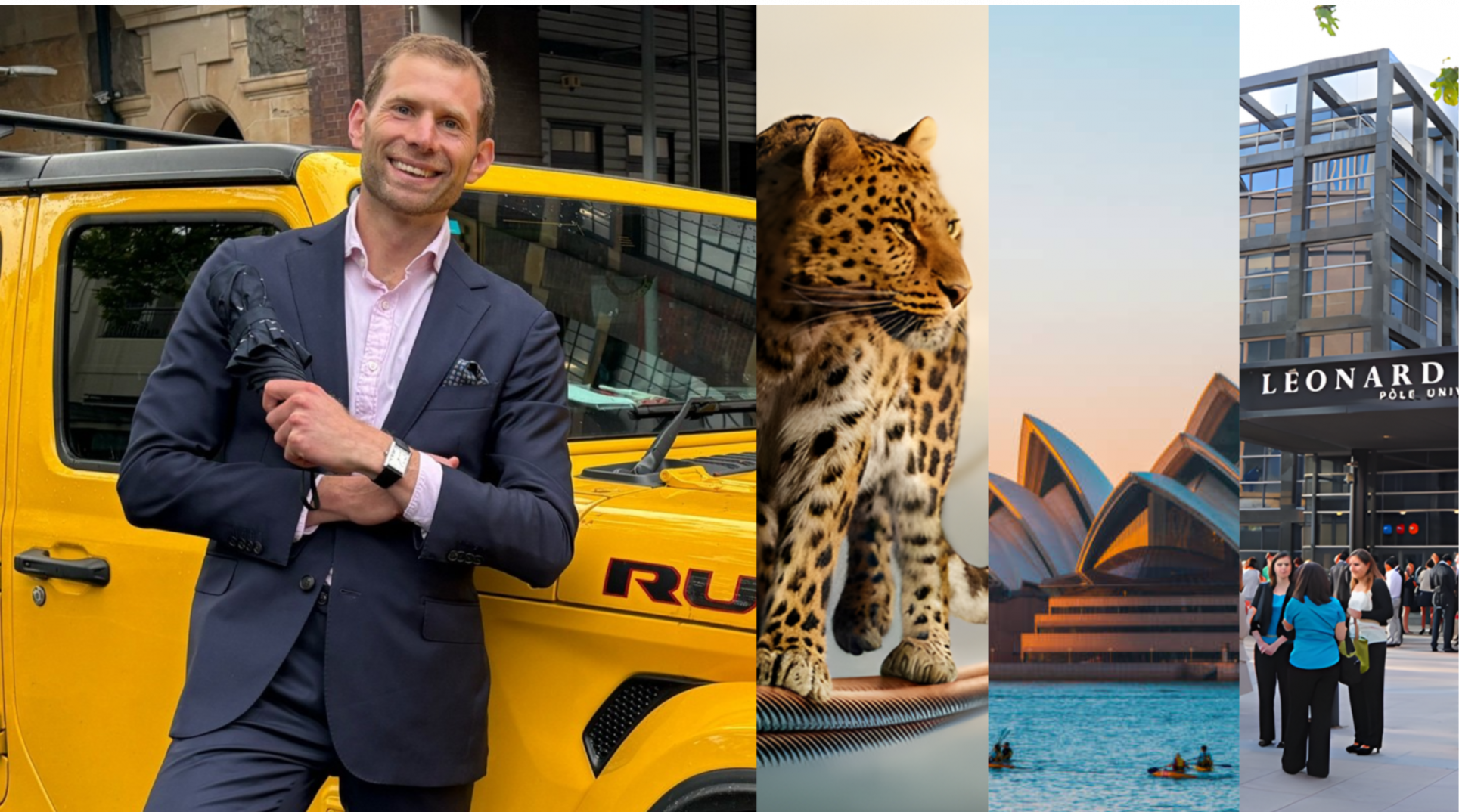

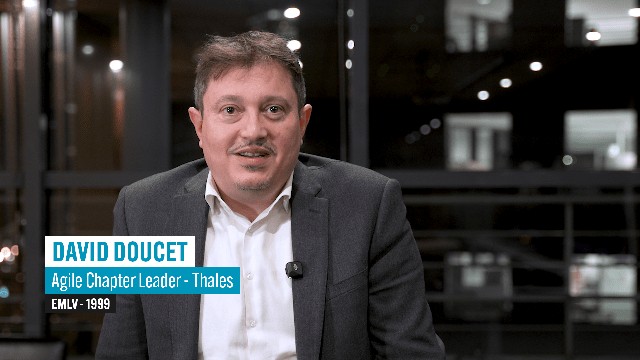
David Doucet, a 1999 graduate of EMLV, has never followed a set path. At the 2025 Alumni Fair, he looks back on his career, where curiosity and daring have been the watchwords, and recounts how changing jobs, venturing into the unknown, and adapting to new technologies have shaped his career. A lesson in agility at every level!
What are the main stages of your career?
I first joined a company called Altran, which no longer exists, having been bought out by Capgemini, to work in web design project management.
Then I worked at Renault for ten years and was headhunted by a recruiter to join Thales, to do technical deployment, because I had acquired that skill. I held several different positions before becoming manager of agile teams. So, in the space of 25 years now, I must be in my 17th position.
Can you tell us about your job?
I work for Thales and I am an Agile Chapter Leader: this involves managing agile resources within IT.
My job is really the pure cliché of a manager. My goal is to make sure my teams are happy to come to work every morning, that they perform better and better, and that they have someone they can count on.
I prefer the role of leader, someone who can answer their questions and help them with technical, functional, process, mobility, retirement, and other issues. And so, having someone who is rather benevolent! I find that this is what qualifies me, being able to help teams develop. And of course, like any manager: also checking that the work that is requested has been done correctly.
What are your current challenges?
The challenges for an Agile Chapter Leader, or a manager for that matter, are to help teams grow and give them a sense of purpose. Obviously, you have to make sure that the work complies with company expectations, but what interests me is the human side. Being able to ensure that, in five, ten, or fifteen years, they will still be at the top of their game.
We don't solve the problems we had 20 years ago in the same way today. We are much more agile, much faster. People change as they go along. I've had 17 different jobs, in operations, technical, management, consulting, sales... you can move around intelligently within a company as long as you're curious, as long as you want to do something else, as long as you're motivated to move. That's the kind of opportunity I'd like my employees to have too: to be able to say, “I've been working in a technical role for fifteen years, now I'd like to work on projects.” So they can bounce back and change career paths.
What are the key factors for success in this profession?
First of all, you have to like people. People who, in my opinion, lack empathy cannot be good managers. You have to understand other people's problems in order to help them.
Another quality, I would say, is taking time for others. A manager or leader has to juggle different financial, budgetary, and personnel issues. You always have to have bandwidth and be ready to put your work on hold to take care of others.
How did your studies contribute to who you are today?
Discovering incredible professors contributed to that!
Didier Schlacther, who passed away this year, was my macro and microeconomics professor. He was an incredible person who taught me to think differently about studying. Studying isn't just a professor talking and a student listening. It's really a constant interaction to fully understand the subject.
Steven Brower, who was our English teacher, was an extremely brilliant person who gave me a taste for linguistic adventure. When I arrived at Pôle Léonard de Vinci, my English wasn't very good. Today, my boss is Australian and I speak to him in English every day.
Any advice for someone embarking on a career like yours?
Be curious and be able to change. If you don't like change, it's difficult to have a career like mine. I work in technology, I work in operations.
It also means being bold, potentially approaching a company and saying, “I have a wealth of experience and I understand all your business lines.”
What really helped me develop was interacting with people. Going back to EMLV, at the time there was also a European program, with semesters abroad. It was important to ask yourself, “How is this taught abroad?” The IIM was also created around that time: it was also interesting to think, “Hey, there are people who are going to work on new technologies, how could I incorporate that into my career path?”
Always be interested in what's going to happen tomorrow and, above all, don't look at what happened the day before yesterday. Otherwise, you'll be left behind.
What does being an alumnus mean to you?
It means sharing certain values that come from education, so there is already a common culture.
Being an alumnus also means being able to help new students find apprenticeships and internships.
It also means saying to yourself: I know the professors who taught them, I know the quality of the education, so I'll be able to find skills that interest me in my current job.
It potentially means sharing moments outside of work with EMLV alumni from 1999. What have they become?
Being around today's and future generations also means challenging yourself every day. For me, that's great. Being an alumnus also means sharing moments with former students. Today, the Léonard de Vinci campus is celebrating its 30th anniversary. This may be an opportunity to bring the younger generations closer to the older ones.
An Alumnus to follow!

Comments0
Please log in to see or add a comment
Suggested Articles