

Julien Delcominète (EXEC.ED. 2024): Making AI understandable in an era of complexity


A digital transformation professional, Julien Delcominète has been Deputy CEO at Netinvestissement since 2022. In 2023, after several months of daily exploration of ChatGPT, he embarked on an ambitious project: to create a dictionary to make artificial intelligence accessible and understandable to as many people as possible. That same year, he enrolled in the AI & Data Innovation MBA program at De Vinci Executive Education, graduating in 2024.
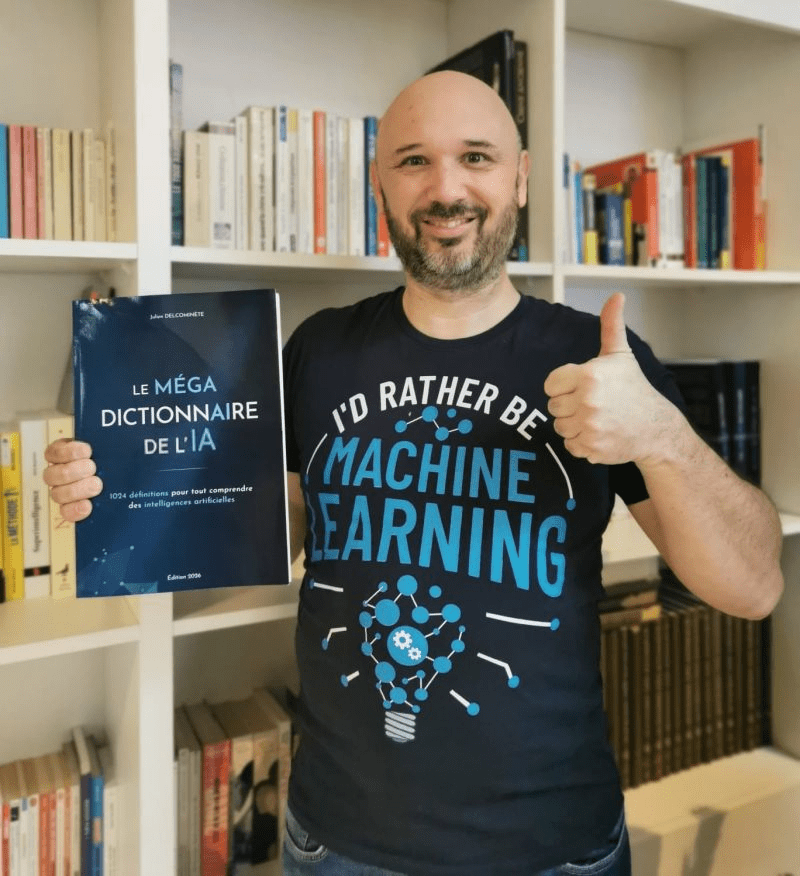
The result of nearly 30 months of work, the Mega Dictionary of AI, released at the end of 2025, brings together more than 1,000 definitions structured into ten themes, enriched with illustrations and links between definitions to shed light on the key issues of AI.
An MBA as a catalyst for a career path already underway
The MBA in Artificial Intelligence offered by De Vinci Executive Education was perfectly suited to my professional goals. It represented the logical next step in my career and a seamless transition to the evolution of my profession and digital marketing. After working for more than 20 years on digital transformation projects for numerous companies, I wanted to structure the strategic expertise I had acquired over time. I strengthened my analytical skills, critical thinking, and diagnostic abilities in the context of complex projects.
A dictionary as a synthesis and anchor for the future
With regard to my book, the MBA nourished and accelerated my writing project by allowing me to move from a logic of inspiration to a logic of construction. Over the months, I gradually wove together the conceptual architecture that would later become the backbone of the book.
This dictionary is a natural synthesis of my professional career and a foundation for my future projects. It is a direct extension of my experience in the field: it is not an isolated theoretical work, but the result of several years of practice, observation, experimentation, analysis, and exchanges with professionals.
Creating something new, between intuition and risk-taking
The first and main risk for me was that the book would not meet a real need among professionals, students, and decision-makers, and would therefore not find its audience. Looking back, and after receiving a lot of feedback, I can now say that this book meets a strong demand, which fully confirms the initial intuition behind the project.
Another significant risk was the rapid evolution of the subject. Working on concepts related to artificial intelligence, which is evolving at an impressive speed, the danger was that certain definitions would quickly become obsolete. This led me to favor an approach based on key concepts, major mechanisms, and fundamental issues, even though I also address current concepts, concrete uses, and current examples in order to anchor the discussion in the reality of the field.
A dictionary designed as a decision-making tool
What sets my dictionary apart from other books on the subject is, above all, its positioning. It is neither a technical manual nor a simplified popularization, but rather a tool for clarification and perspective, intended to accompany reflection and decision-making. I have also taken care to maintain a high degree of objectivity in my treatment of concepts and uses, avoiding ideological or overly enthusiastic discourse in order to offer a factual reading of the notions addressed. The definition devoted to AGI is a particularly representative example of this.
Perspectives and reflections on AI
The concept that appeals to me (and I am not alone) is clearly that of AGI. I was struck by the gap between the technical reality of current models and the way AGI is promoted in communications by some major players in the sector, led by OpenAI, often with a view to seeking funding from investors. My research has led me to take a closer look at the intrinsic limitations of current models: systems based on statistical correlations, devoid of intention or representation of the world in the human sense of the term. This calls into question many arguments that tend to equate apparent performance with real intelligence. In this regard, work on world models, particularly that carried out by Yann Le Cun, has been particularly enlightening.
Common misconceptions about AI
What strikes me most is the misuse of language that consists of talking about artificial intelligence as if it were a homogeneous block. This view is misleading. In reality, there are a variety of types of artificial intelligence (connectionist, symbolic, hybrid, etc.) based on very different approaches, logics, and purposes. Generative artificial intelligence, which is currently receiving a lot of media attention, is just one type of AI among many others. As such, it would be more accurate, and above all more rigorous, to systematically refer to artificial intelligences in the plural.
Writing a book alongside your career: discipline above all else
Embarking on an entrepreneurial project alongside your job requires a great deal of determination, but also a great deal of discipline. My first piece of advice would therefore be to accept from the outset that this project will be built in the evenings, on weekends, and in the gaps left by your professional life. This means setting clear boundaries, with realistic goals and, above all, dedicated time that you commit to respecting.
Writing a book is not a sprint, but rather a long-distance race. For me, it took nearly 30 months. With this in mind, consistency is key: it is better to produce little but regularly than to work in bursts. It is this continuity that allows you to stay committed over time.
What helped me was celebrating “small victories,” which are essential for maintaining motivation over time. I would also advise involving your family from the very beginning of the project. The support and understanding of loved ones provide valuable energy and allow you to approach the required effort with much more serenity, especially during the most demanding periods.
Three key criteria for a successful technology project
First, start with a real and clearly identified need: technology must remain a means to a specific end, not an end in itself. Artificial intelligence, for example, offers many possibilities, but it is not suitable for all problems.
Next, rely on rigorous and structured execution, with clear priorities and controlled implementation. This is often the factor that makes the difference between the success and failure of a project.
Finally, cultivate a capacity for continuous learning and adaptation, because technologies, like market expectations, evolve rapidly and require constant re-evaluation.
An alumnus to follow!
Get The MEGA Dictionary of AI:


Comments0
Please log in to see or add a comment
Suggested Articles